
Gaza on the Back Burner: Why Regional Diplomacy Without a Just Resolution for Palestine Will Fail
By Dr. Jehad Abusalim
Policy papers published by the IMEU Policy Project reflect their authors’ viewpoints.
Executive Summary
The United States has turned to diplomacy across the Middle East, not by choice but by necessity. The war on Iran did not deliver the surrender Washington sought, and the fighting in Lebanon has refused to end on Israeli terms. Out of that reality came a memorandum of understanding with Iran, a de-confliction channel to slow the fighting in Lebanon, and a direct demand from President Trump that Saudi Arabia and other Arab states join the Abraham Accords as the price of the Iran deal’s success, with the late Senator Lindsey Graham warning of “severe repercussions” for any state that refused. Negotiation returned to the forefront of the agenda because force had exhausted its returns, not because Washington rediscovered its value. Yet against the backdrop of these shifts, Gaza remains the exception. The place where the current regional war began is the one place where US diplomacy has stalled.
Nine months after the October 2025 ceasefire, its central promises remain unmet. Israeli strikes have continued, killing more than one thousand Palestinians after the guns were supposed to have fallen silent. Reconstruction has barely begun. The Palestinian committee meant to administer Gaza has not been allowed to enter it. Israeli forces still hold more than half the territory, and Israel’s military chief has declared the ceasefire line a new border. The machinery built to end the war, the Board of Peace chaired by the US president, has met in Washington while Palestinians in Gaza wait in tents under severe conditions.
This is not a new mistake. It is the oldest one in US policy toward the region: the belief that the Palestine question can be managed rather than resolved. The pre-October 7 order was built on that belief. The Abraham Accords normalized Israel’s relations with Arab states while treating Palestinians as a problem to be contained. That arrangement did not deliver stability. It collapsed into the deadliest year in the history of the issue.
The current approach repeats the design and should be expected to repeat the result. There will be no durable calm in the region while Gaza remains destroyed and Palestinians remain excluded from decisions about their own future. US public opinion has already moved: for the first time in a quarter century, more Americans sympathize with Palestinians than with Israelis. US policy has not caught up. This paper argues that it must, and offers four recommendations for Congress, the executive branch, and policy makers:
Enforce the ceasefire’s existing terms. Condition and restrain US support to compel a genuine halt to Israeli strikes, an end to the killing of Palestinians along the “yellow line,” and adherence to the withdrawal timeline Israel has ignored.
Drive real aid and reconstruction. Use US leverage to remove the obstacles blocking recovery: the “dual-use” restrictions, the closure of Rafah to goods, the bans on UNRWA and international NGOs, and the withheld reconstruction funds.
Refuse regional deals that exclude Palestinians. Stop advancing normalization tracks, including any expansion of the Abraham Accords, that are structured to bypass the Palestinian question rather than resolve it.
Insist on Palestinian agency in Gaza’s governance. Condition US support for any transitional arrangement on genuine Palestinian representation and a credible path to self-determination, not administration by outside actors over Palestinians’ heads.
The Paradox of the Moment
In the first half of 2026, US diplomats were busy everywhere in the Middle East except where the fire started. A 14-point memorandum of understanding with Iran, signed in June, opened a 60-day process covering the Strait of Hormuz, Iran’s nuclear program, and sanctions. A US-Iran “de-confliction cell” was set up to halt the fighting in Lebanon. The late Senator Lindsey Graham spoke openly of expanding the Abraham Accords and accomplishing Saudi Arabia normalization with Israel before year’s end. As of this writing, the ceasefire has broken down as the US and Iran continue to exchange fire with the long-term ramifications for a permanent deal left up in the air.
Gaza received no such diplomatic engagement. In January 2026, US envoy Steve Witkoff announced that the ceasefire had entered its second phase (despite Israel’s refusal to abide by its first phase commitments), which was meant to deliver Israeli withdrawal, an international stabilization force, and the reconstruction of the Strip. By spring, the phase had stalled. Nikolay Mladenov, the veteran diplomat appointed to oversee Gaza for the Board of Peace, told the U.N. Security Council that implementation could not advance through Palestinian obligations alone, and warned that the deteriorating status quo, a divided Gaza under permanent Israeli military control, risked becoming permanent.
The contrast is the argument of this paper. The United States has concluded that the crises in Iran and Lebanon require diplomacy, concessions, and sustained high-level attention. It has not reached the same conclusion about Gaza, even though Gaza is the wound from which the entire regional war spread. The question is why the place at the center of this regional unraveling has been placed at the margins of the effort to end it, and what that exclusion will cost.
Gaza since 1948
To understand why the current effort is failing, one has to understand what the Gaza Strip is, and how it was created. Gaza’s crisis did not begin on October 7, 2023, or with the Israeli blockade beginning in 2005, or with Hamas’s electoral victory in 2006. It began in 1948.
The majority of Gaza’s population are refugees, or the descendants of refugees, expelled from towns and villages in what became Israel during the Nakba, the catastrophe of 1948 in which roughly 750,000 Palestinians were driven from their homes. A strip of land that had held around 80,000 people absorbed more than 200,000 of the dispossessed. They were never allowed to return. That denial, not poverty, not militancy, is the original and defining fact of Gaza. Everything since has been built on top of it.
For the next two decades Gaza was under Egyptian administration, then, after 1967, under direct Israeli military occupation. Israel controlled its land, water, the movement of its people, and economy, and cultivated a dependency it would later use as leverage. In 2005, Israel withdrew its settlers and soldiers from inside Gaza and called it a “disengagement.” It was not the end of occupation. Israel retained control of Gaza’s borders, airspace, coastline, population registry, and the movement of every person and every good in and out. What changed was that Israel no longer had to govern the people it controlled from within. It could seal them off instead.
After Hamas won Palestinian legislative elections in 2006 and took control of Gaza in 2007, Israel, with Egyptian cooperation and US acquiescence, imposed a comprehensive blockade that remains the central fact of life in Gaza to this day. The blockade was not merely a security measure. Israeli officials described its logic plainly. The policy slogan repeated at meetings of the Israeli defense ministry body overseeing the blockade was ‘no prosperity, no development, no humanitarian crisis.’ The scholar Sara Roy named this process de-development: not underdevelopment, not stagnation, but the deliberate dismantling of an economy’s capacity to grow. Gaza was not poor by accident. It was made poor by policy.
For sixteen years before the current war, Gaza was subjected to this containment, punctuated by repeated Israeli military assaults in 2008-2009, 2012, 2014, 2021, each described at the time as a discrete operation, each leaving more destroyed and less rebuilt. This was the “manageable” Gaza that US policy accepted: sealed, impoverished, periodically bombed, and kept off the diplomatic agenda. October 7 did not come from nowhere. It came from there.
The US Role
The United States did not observe Gaza’s destruction from a distance. It actively played a role in it. Across two administrations, US policy moved from active provision of the weapons that leveled Gaza to active interference with the aid meant to keep its people alive.
Under President Biden, the United States provided the bombs, the diplomatic cover, and the vetoes. It transferred billions of dollars in munitions to Israel during which a UN Commission of Inquiry and the world’s leading genocide scholars concluded a genocide was underway. It repeatedly shielded Israel from binding action at the Security Council. And when domestic and international pressure forced a humanitarian response, the response itself became a mechanism of evasion. The floating pier off Gaza’s coast, announced with fanfare in 2024, delivered a fraction of what trucks could have carried and collapsed within weeks, while the land crossings Israel controlled remained throttled. Airdrops, expensive and dangerous, scattered aid that sometimes killed the people it fell on. These were not serious efforts to feed Gaza as Israel was deliberately starving it. They were substitutes for the one thing that would have worked, and that Washington declined to demand: opening the crossings and ending the siege.
Under President Trump, the pattern continued in a harsher form. The Gaza Humanitarian Foundation, the US- and Israeli-backed scheme that replaced the UN’s distribution network in 2025, funneled a starving population into a handful of militarized sites where hundreds were killed seeking food. It was aid redesigned as a trap. The through-line across both administrations is unbroken: the United States retained, at every moment, the leverage to halt the killing and open the flow of aid, and at every moment chose not to use it. Complicity is not too strong a word. It is the accurate one.
An Accounting of the Diplomatic Effort
The Comprehensive Plan to End the Gaza Conflict, announced by President Trump in September 2025 and endorsed by the U.N. Security Council in Resolution 2803 that November, seemed real in its first phase. The fighting paused. Hostages and prisoners were exchanged. Humanitarian aid surged after nearly two years of engineered scarcity. These were real, measurable changes for a population that had endured two years of bombardment. But an end to bombardment is not a resolution, and what followed in the months after exposed the distance between the two.
The problem lies in what the plan built and what it left unbuilt. The Board of Peace, chaired by the US president with sweeping authority over its operations, met for the first time in Washington in February 2026. Twenty-seven countries signed on; most NATO allies declined, citing the vagueness of the board’s charter and its invitation to states whose leaders face international arrest warrants. The board supervises a 15-member National Committee for the Administration of Gaza, led by former Palestinian minister Ali Shaath and composed of Gazans, most of whom have worked with the Palestinian Authority. That committee is based in Egypt. As of this writing, not one of its members has been permitted to enter Gaza, and no timeline exists for when that will change.
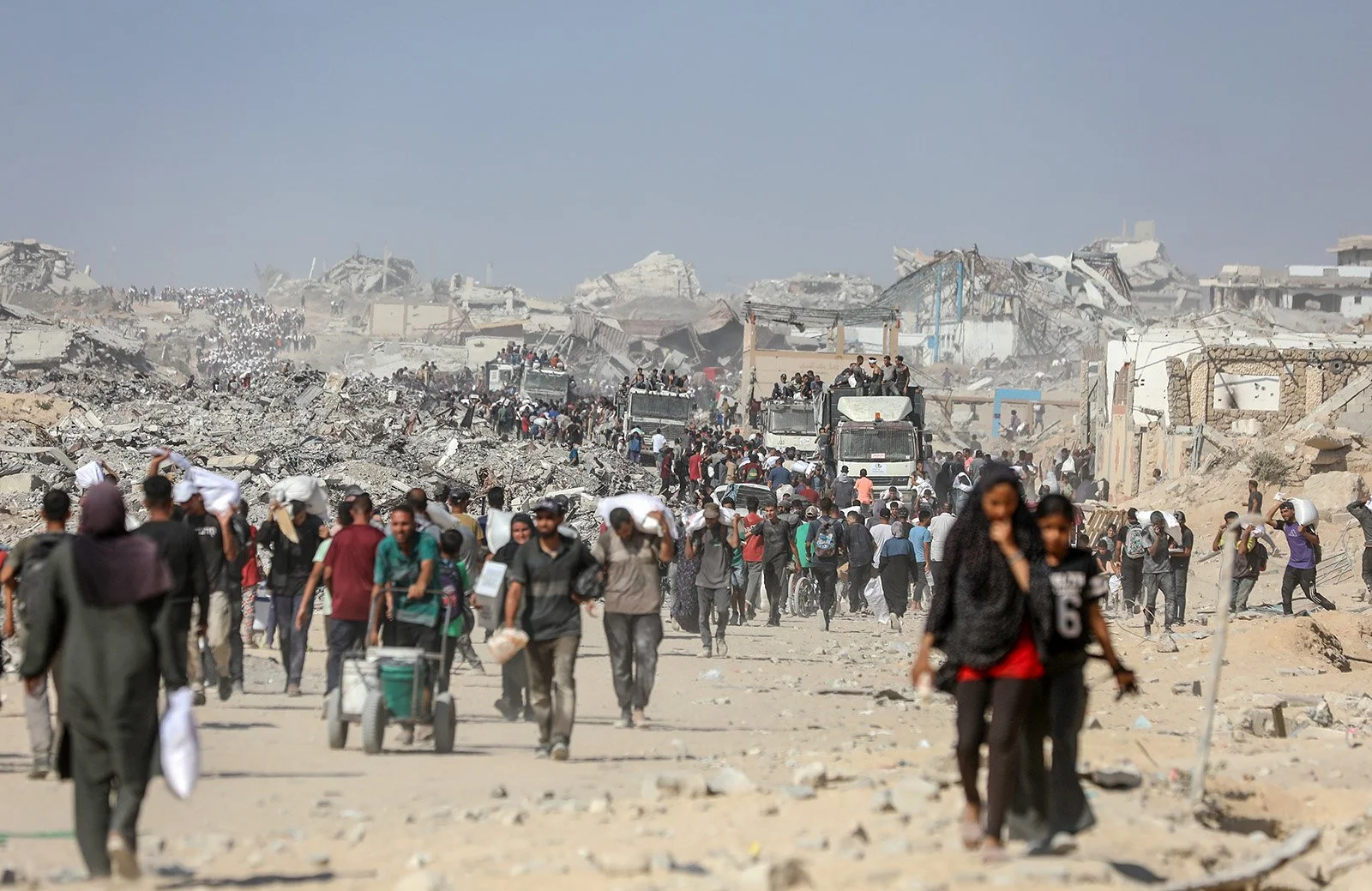
Consider what that means. The body meant to govern Gaza cannot set foot in Gaza. The board meant to rebuild it convenes an ocean away. Six months into the ceasefire, reporting on the reconstruction fund found that just half a percent of Gaza’s rubble had been cleared, and that donor pledges to the World Bank-administered fund had largely gone unmet, with the board pressing member states to convert promises into cash. As of April 2026, 77 percent of the population still faced high levels of acute food insecurity, according to the UN’s Integrated Food Security Phase Classification. More than 18,500 patients, suffering from trauma wounds, cancer, and chronic disease, still required treatment unavailable in Gaza, and only a few hundred had been allowed to leave through Rafah since it reopened in February.
The plan front-loads Palestinian obligations and leaves Israeli obligations unenforced. Hamas was required to release hostages and the remains of the deceased, and did. It was pressed to disarm on a sequence set by the board. Israel, meanwhile, has conducted no further withdrawal since the initial pullback of October 10. It has built fortifications along the ceasefire line rather than retreating from it. Its military chief of staff declared in December 2025 that the “yellow line” would be Israel’s new border in Gaza, in direct contradiction to the plan’s stipulation that Israel would neither occupy nor annex the territory. When Mladenov told the Security Council that the process ‘cannot advance through Palestinian obligations alone,’ he was naming the problem precisely. On paper, the plan’s obligations run both ways. In practice, only Palestinians are held to theirs. Hamas gave up its central leverage, returning the hostages and the remains of the dead, and has signaled willingness to disarm on a path to statehood. Israel, required to keep withdrawing, has done the opposite: pushing the yellow line deeper into the territory it was meant to leave, seizing more ground, and killing Palestinians on a near-daily basis.
Annexation by Increment
Israel’s refusal to withdraw is not passive. It is expansion by increment. Israeli forces now control between 53 and 58 percent of Gaza from behind the yellow line, and the line has crept outward, not inward, since the ceasefire began. Reporting indicates Israeli control approaching some 70 percent of the territory in practice when buffer zones and areas of operation are included. This is de facto annexation conducted slowly enough that each step can be denied, but permanent enough in nature that the cumulative result is a fact on the ground.
Israeli officials have even stopped bothering to deny it. Finance Minister Bezalel Smotrich, who holds authority over civilian administration in the occupied territories, has stated that plans for the recolonization of Gaza are prepared and awaiting only Prime Minister Benjamin Netanyahu’s approval. The settler movement that built the West Bank’s outposts has openly announced its intention to return to Gaza, from which Israel withdrew settlers in 2005. What the Trump plan on paper forbids–occupation and annexation–the Israeli government is preparing to carry out in daylight, while the Board of Peace raises no objection.
A Ceasefire That Did Not Stop the Killing
The word ceasefire implies that fire has ceased. In Gaza it has not. By June 2026, Israeli attacks after the October 10 ceasefire had killed roughly 900 to nearly 1,000 Palestinians, according to figures compiled by monitors and Gaza authorities, and reported in the international press. Palestinians are killed and then described, after the fact, as having approached the yellow line, the boundary Israel drew to mark its own withdrawal that it has since refused to complete. The line functions less as a demarcation than as a license for killing. Cross an invisible threshold in your own city and you may be shot.
For the two million people living beside that line, the ceasefire has not been a process of recovery. It has been a lull inside a catastrophe. Roughly ninety percent of Gaza’s civilian infrastructure has been destroyed. Most hospitals are damaged or nonfunctional. Water, electricity, and sanitation systems have collapsed. Nearly the entire population was displaced during the war, and hundreds of thousands remain exposed to the elements. The aid that entered after October eased the worst of the starvation, but it did not rebuild a single neighborhood, because the restrictions that throttled Gaza before the ceasefire–the ban on “dual-use” materials that includes the shelter and construction supplies people need–remain in force.
A family that survived two years of bombardment now continues to live in a tent, in a territory where the rubble has not been cleared and the committee charged with clearing it cannot enter. This is the continuation of the genocide by other means, with a ceasefire’s name attached to it.
Reconstruction as Real Estate
What is being called reconstruction is not, in its design, for Palestinians. At the Davos gathering in January 2026, President Trump’s son-in-law and adviser Jared Kushner presented a vision for postwar Gaza: a coastal development of some 180 skyscrapers, tourism zones, data centers, and “New Gaza” and “New Rafah” districts as components of a $30 billion master plan pitched to investors. Kushner had described Gaza’s shoreline in 2024 as “very valuable” waterfront property and mused that Israel should clear its civilians and develop it. The plan unveiled two years later is that musing turned into a prospectus.
This is a blatant attempt to substitute investment for rights, and it has been tried before. The logic runs back to Oslo: offer Palestinians prosperity, or the promise of it, in exchange for abandoning political claims. It has never worked, because it addresses the symptoms of Palestinian dispossession while entrenching its cause. A tourism economy without freedom of movement is not freedom. Skyscrapers built over the rubble of destroyed neighborhoods, over graveyards and universities and the homes of the displaced, are not recovery. They are erasure with a groundbreaking ceremony.
The deeper design should be named plainly. Gaza has long functioned as an incubator of Palestinian defiance, the place where the refusal to accept dispossession has been most concentrated and most costly to Israel. A plan that dismantles Gaza’s physical fabric through destruction, and then proposes to dismantle its social and cultural fabric through redevelopment, is not neutral about that history. It aims to build over the thing that made Gaza Gaza. Foreign investors and the plan’s architects, some of whom stand to profit directly, would inherit a coastline cleared of its meaning. This is not reconstruction. It is the final stage of the container logic: if Gaza cannot be governed or contained, it can be redeveloped out of existence.
Ignoring Gaza Has Always Produced Catastrophe
The instinct to manage Gaza rather than resolve it is not new, and its results are on the record. For most of the last two decades, US and Israeli policy treated Gaza as a container: blockaded, periodically bombed, and otherwise kept off the agenda. The theory held that a population could be sealed off and its political demands deferred indefinitely, while diplomacy proceeded elsewhere. The theory was wrong every time it was tested, and it was tested at rising cost.
The clearest expression of that theory was the Abraham Accords. Signed in 2020, they normalized Israel’s relations with the United Arab Emirates, Bahrain, and others on an explicit premise: that the Palestinian question could be set aside. Peace would be built between states, over the heads of the stateless. The Palestinians were not partners to the arrangement. They were the item the arrangement was designed to route around. For years this was celebrated in Washington as a breakthrough, a new Middle East in which Israel’s integration no longer required reckoning with the people it occupied.
That order did not produce stability. It produced October 7, 2023, and the two years of catastrophe that followed: tens of thousands of Palestinians killed, more than a thousand Israelis killed, a genocide as found by a U.N. Commission of Inquiry, and a regional war that pulled in Lebanon, Iran, Syria, and eventually US forces. The lesson is that an arrangement built to exclude a people with unresolved claims does not resolve those claims. It defers them, and deferral is not stability. It is pressure accumulating behind a wall that everyone has agreed not to look at.
Palestinians warned that this was coming. They said, through their political movements, their scholars, and their civil society, that no regional settlement could hold while their dispossession went unaddressed. Those warnings were dismissed as maximalism or ignored as noise. They were neither. They were an accurate description of how the arrangement would fail.
gaza at the Margins of the Regional
The realignment now underway carries the same design flaw. Washington is working to close out its confrontations across the region because it has run out of better options. The war on Iran did not produce the capitulation it was meant to, and the fighting with Hezbollah in Lebanon has proven no easier to end by force than to end by talk. The Iran memorandum, the Lebanon de-confliction channel, and the renewed push toward expanding the Abraham Accords all reflect a real preference for winding down rather than escalating. But Gaza has been sorted into a separate and lower tier. It is treated as a humanitarian file to be administered, not a political question to be resolved, and certainly not a precondition for the wider peace the United States says it wants.
The late Senator Graham’s framing is telling in this context. In his account, the plan is to control the Strait of Hormuz, expand the Abraham Accords, and normalize Saudi Arabia relations with Israel, ending, as he put it, the Arab-Israeli conflict in 2026. Gaza, and the Palestinians, in general, appear in this vision as an obstacle to be cleared, not a party to be included. It is the pre-October 7 logic restored, with the ruins of Gaza as its backdrop rather than its warning. As the Iran war absorbed the region’s attention through the spring, analysts noted the predictable effect: with the world distracted, neither Israel nor Hamas faced pressure to advance the ceasefire, and conditions in Gaza worsened while the diplomatic energy flowed elsewhere.
This is the back burner in operation. Not a decision to abandon Gaza, but a decision to handle it later, separately, as a matter of aid and administration while the real diplomacy happens on other tracks. It is the same bet the Abraham Accords and its architects and proponents made. There is no reason to expect a different outcome from the same wager.
What the US Public Actually Wants
There is a further reason this trajectory is untenable, one that speaks directly to elected officials: it no longer reflects the public they answer to. In February 2026, for the first time since Gallup began asking the question in 2001, more Americans said they sympathized with Palestinians than with Israelis, by 41 to 36 percent. For twenty-four years, Israel had held that lead by double digits. Among Americans aged 18 to 34, a majority now sympathize more with Palestinians, and sympathy for Israel in that group has fallen to a record low. Among Democrats, the margin is 65 to 17 percent. Independents, who once leaned strongly toward Israel, have joined the shift.
The movement extends past sympathy to policy. A majority of Americans favor the establishment of a Palestinian state. Polling has found that roughly two-thirds of Democrats and more than four in ten independents describe Israel’s conduct in Gaza as genocide or its equivalent. A plurality say the current administration’s policy is too pro-Israel. And on the specific question of US entanglement, the public wants what it wants across most of its foreign policy: less war, fewer open-ended commitments, and diplomatic solutions rather than military ones.
This is the gap. A public that has turned decisively toward Palestinian rights and toward de-escalation is being governed by a policy that keeps Gaza destroyed and excluded while advancing normalization deals designed around it. Party leadership in both chambers has lagged behind its own voters badly on this question, although Democrats are starting to catch up as evidenced by 85 percent of Democratic Senators voting to block specific weapons deliveries to Israel in April 2026, and by a plurarity of Democratic Representatives voting to end all taxpayer-funding of weapons to Israel in July 2026. Nevertheless, that gap remains and is not stable. It is already reshaping Democratic primaries–with outspoken advocates of Palestinian rights winning their elections, and, in some cases, defeating AIPAC-backed incumbents–and it will keep widening until policy moves toward the public rather than away from it.
Recommendations
There will be no durable stability in the region without a just resolution of the Palestine question, and no such resolution is possible while Gaza is left in ruins and Palestinians are excluded from decisions about their future. The following recommendations follow from that proposition. They are addressed to Congress, to the executive branch, to policy makers, and to a public whose support for them already exists.
Enforce the ceasefire’s existing terms rather than negotiating new ones. The October 2025 ceasefire already obligates Israel to halt military operations and proceed toward withdrawal. Those obligations are being ignored while the killing continues along the yellow line. Congress should use its authority over security assistance, including reporting requirements, conditions, and the leverage of appropriations, to compel compliance with the terms Israel already accepted. The United States should not treat the daily killing of Palestinians under a ceasefire as an acceptable background condition of diplomacy. Ending these killings should be the goal of diplomacy.
Drive real aid and reconstruction by removing the obstacles to it. Reconstruction has not stalled for lack of a plan; it has stalled because entry is blocked. The executive branch should press Israel to revise the “dual-use” list that bars shelter and construction materials, to fully reopen Rafah to goods and to patients requiring evacuation, and to reverse the measures that have forced UNRWA and international NGOs out of Gaza. Congress should condition relevant assistance on the unobstructed flow of humanitarian and reconstruction supplies and should press donor states and the Board of Peace to release the funds they have pledged but withheld. Rebuilding must aim at enabling Palestinians to remain on their land, not at managing their displacement.
Refuse to advance regional deals structured to exclude the Palestinian question. The United States should stop treating normalization as a substitute for resolution and rights. Any expansion of the Abraham Accords, including Saudi normalization, that is designed to bypass Palestinian rights rather than secure them repeats the error that preceded October 7. Congress and the executive branch should make clear that US diplomatic capital will not underwrite arrangements built over Palestinians’ heads, and should tie US support for regional integration to concrete realization of Palestinian self-determination.
Insist on genuine Palestinian agency in Gaza’s governance. A committee that cannot enter Gaza, supervised by a board an ocean away and chaired by a foreign head of state, is not Palestinian self-governance. It is administration of Palestinians by others. The United States should condition its support for any transitional arrangement on real Palestinian representation, on the physical presence of Palestinian administrators inside Gaza, and on a credible, time-bound path from transitional governance to Palestinian self-determination. Palestinians are political actors with the right and the capacity to govern themselves. US policy should treat them as such.
Conclusion
The United States has turned to diplomacy in the region because force did not deliver what it promised. It is applying that judgment to Iran and to Lebanon. It is withholding it from Gaza, the one place where it is most needed and where its absence is most dangerous. The pattern is familiar. Every arrangement that has tried to build peace around the Palestinians rather than with them has failed, and the most recent such arrangement failed catastrophically, in full view, at a cost measured in the tens of thousands of dead.
The current approach differs from the last one in its details, not its design. It still treats Gaza as a file to be managed rather than a people to be reckoned with. It still defers the Palestinian question in the belief that regional peace can be assembled without it. That belief was wrong before October 7 and it is wrong now, and Palestinians, who warned of the last collapse, are warning of this one. The choice before US policymakers is whether to hear them this time. There will be no calm in the region built on Gaza’s ruins. There will only be the next accumulation of pressure behind the next wall that everyone has agreed not to look at.